


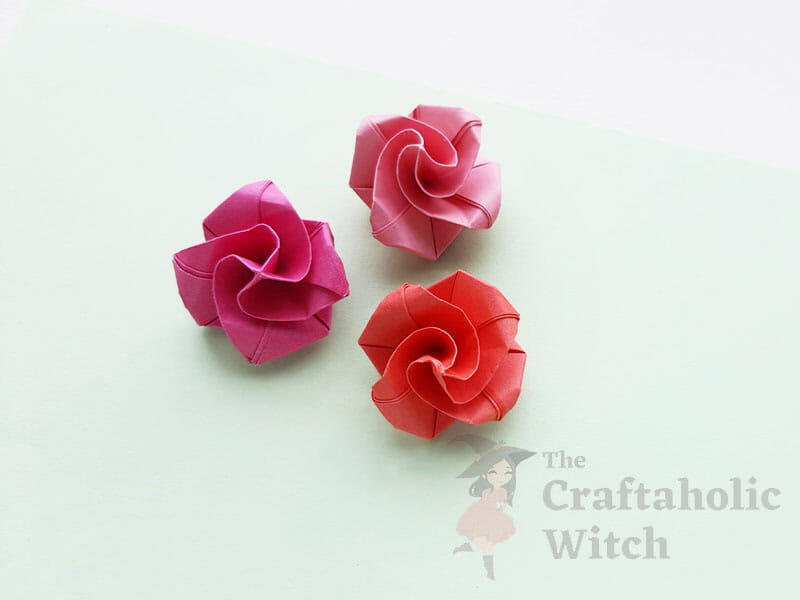
You can fold a single square of paper into a fully bloomed origami rose in about 15 to 20 minutes on your first try, using nothing but craft paper and a pair of scissors. It’s an intermediate project built around one tricky twisting move, so it rewards patience more than speed, and it makes a rose that never wilts, perfect for a card, a gift, or a spot in your own paper flower garden.
This rose is part 4 of our Fold a Paper Flower Garden series, a five-tutorial project that builds one blooming paper garden out of five different origami flowers. In the finished arrangement, roses do the detail work: fold 6 to 10 of them and tuck them along the front edge, into the corners, and into any gaps between the taller flowers, so the garden looks full instead of sparse. If you’re starting the series from scratch, the tulips go in the tall back row first, the lilies add bold color through the middle, and the lotus flowers fill out the base before these roses go in last to close the gaps.
Outside the garden, a finished rose still earns its keep. Glue one to a gift box or a handmade card for an embellishment that never wilts, or fix the flat base onto a bookmark or hair clip for a small, sturdy keepsake. A handful in a jar makes a permanent bouquet that never needs water either.
Origami Rose at a Glance
- Difficulty: Intermediate
- Time: 15 to 20 minutes at first, 8 to 10 minutes once you’ve made a few
- Cost: Under $1 (one sheet of paper)
- Ages: 10 and up; younger folders may need help with the final twist
- Best for: filling gaps in a paper flower garden, card and gift embellishments, no-wilt bouquets
Join Craft Challenge: Craft Your Calm
Make something that brings you a sense of peace, share a photo, and tell us your story. It's free to enter, open to everyone, and the entry with the most reactions takes home a $100 gift card. Takes five minutes to join.
Entries close August 30, 2026. No purchase necessary.
What You Need to Make an Origami Rose
Materials
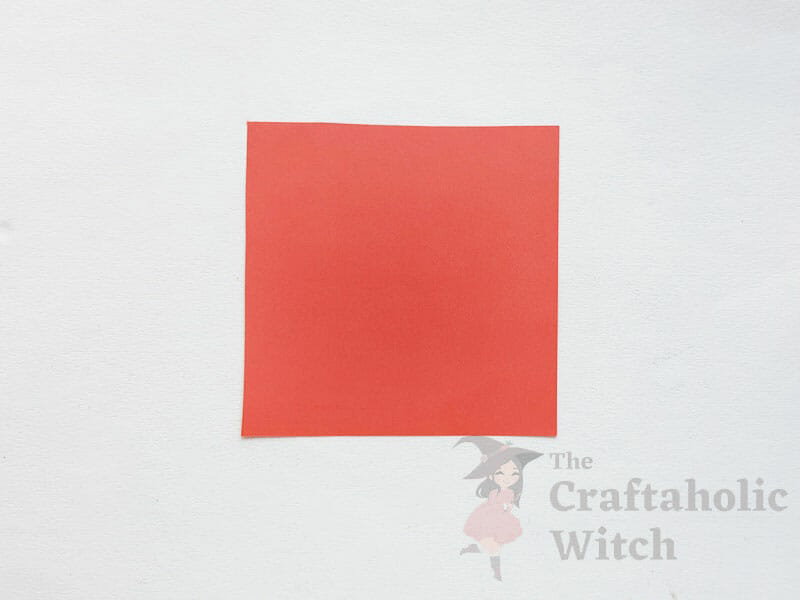
- Square colored craft paper (6×6 inches or 8×8 inches recommended, 65-80 lb weight) – lighter paper tears easily during the final twist, while cardstock is too stiff to create the delicate rose petals. Choose red, pink, or traditional rose colors for realistic looks. (Alternative: cut standard printer paper into squares, though it won’t hold creases as crisply)
Tools
- Sharp scissors – dull scissors create uneven edges that show in the final rose
Ask inside "Crafty Q&A" while you are making.
"Crafty Q&A" is free to join. Share your question, photo, or the exact step where you got stuck, and chat with other makers plus the Craftaholic Witch team. You can also join any discussion thread already happening inside the space.
Watch How to Fold an Origami Rose
Since this origami rose has some complex folding techniques, we strongly recommend watching the complete video tutorial before you start folding. This is not an easy tutorial to follow on the first try, so seeing the entire process in motion will help you understand what each step should look like.
The video walks through all 18 folds in real time, including the final twist that trips up most first attempts.
Step-by-Step Instructions
Step 1: Make the Basic Fold Lines
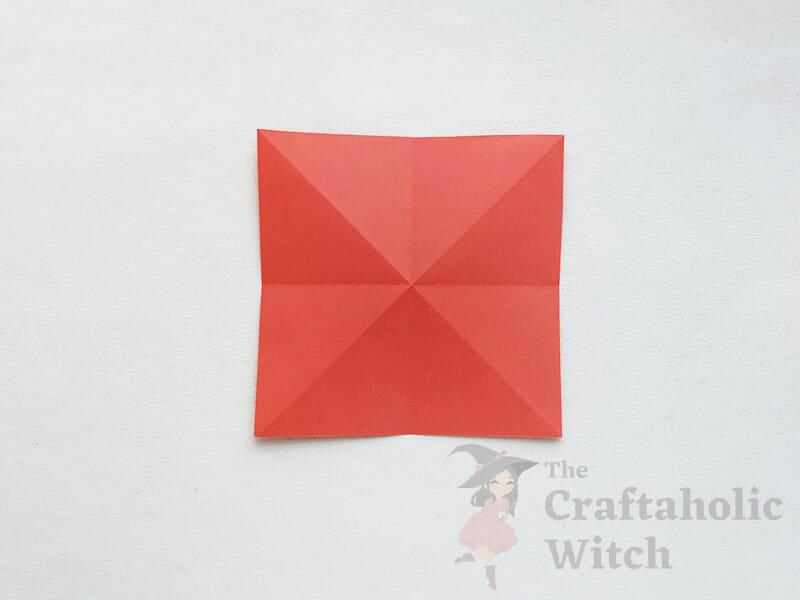
Take your square paper and fold it in half vertically, crease firmly, then unfold. Fold it in half horizontally, crease, then unfold. You should now have a plus sign (+) crease pattern on your paper.
Flip the paper over to the other side. Fold it diagonally corner to corner, crease well, then unfold. Fold diagonally the other way, crease, then unfold. Your paper should now have both straight and diagonal crease lines forming a star pattern.
Pro Tip: Make your creases as sharp and precise as possible. Run your fingernail along each fold. These initial creases are the foundation of your entire rose, and neat creases make the rest of the process much easier.
Step 2: Collapse the Paper into a Star Shape
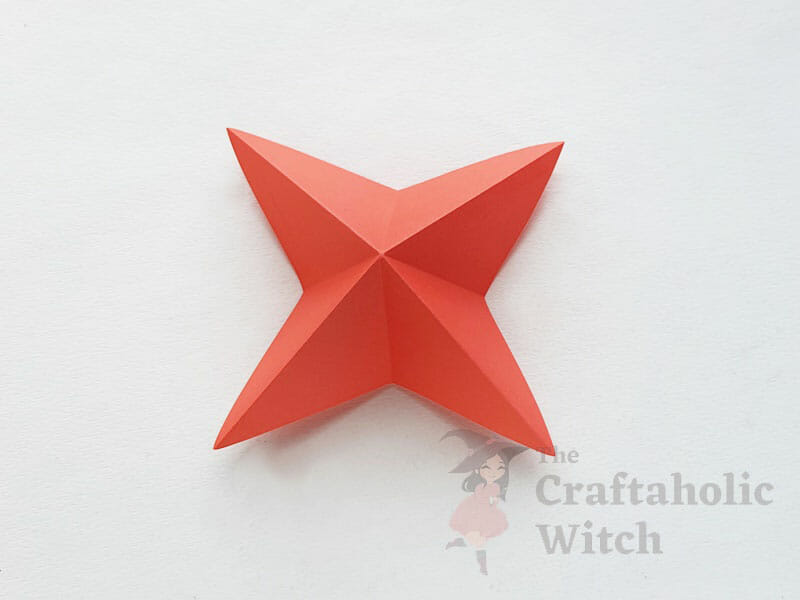
Push the diagonal creases upward while pushing the straight creases inward. The paper will naturally want to collapse into a four-pointed star shape. Gently guide it into this position.
Don’t force it. The creases you made in Step 1 should guide the paper to collapse naturally into the star formation.
Step 3: Press the Star Flat into a Triangle
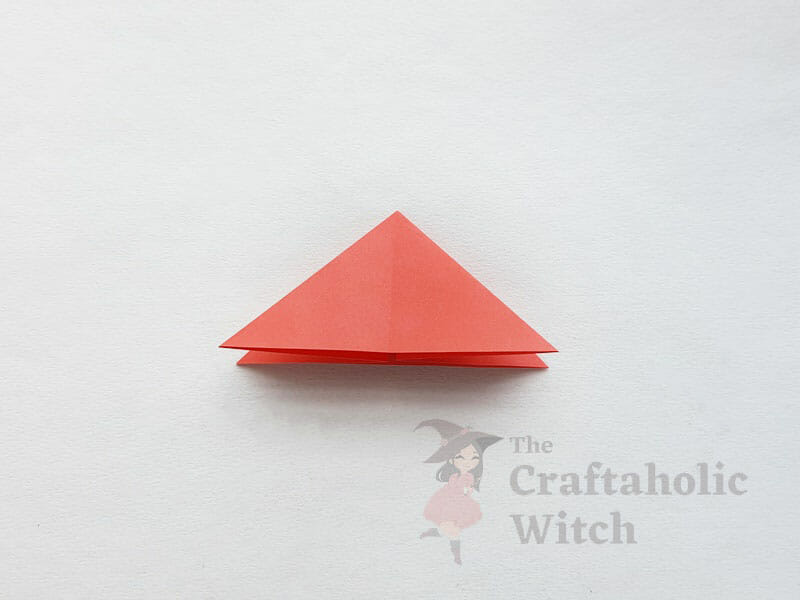
Bring the four points of the star together and flatten the entire shape. You’ll end up with a layered triangle with a point at the top and a folded edge at the bottom. Make sure all layers are aligned neatly.
Common Mistake: Some layers might stick out unevenly. Take a moment to align all edges before pressing flat.
Step 4: Fold the Bottom Corners Up to the Top
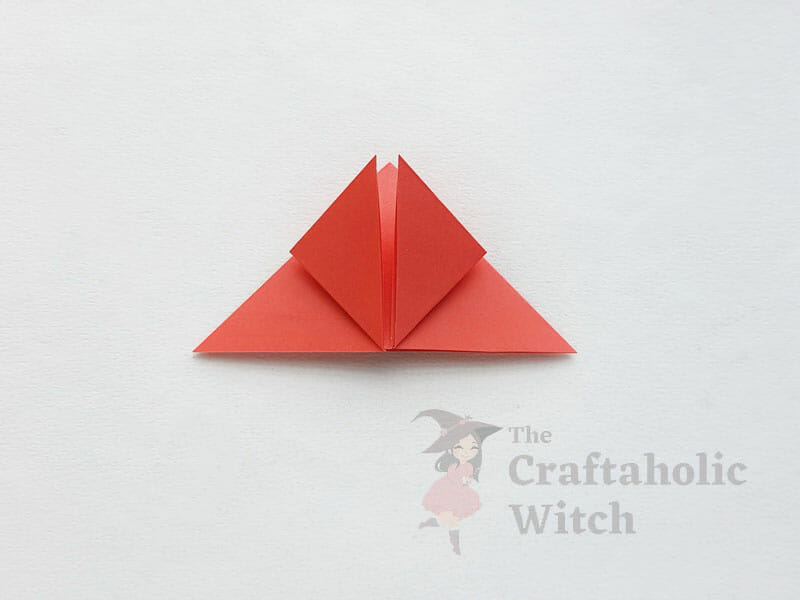
Working with just the top layer, fold the bottom left corner up to meet the top point of the triangle. Crease well. Repeat with the bottom right corner. You should now have a diamond shape on the top layer.
Make sure you’re only folding the top layer at this stage, not all layers together.
Step 5: Open the Corner Pocket
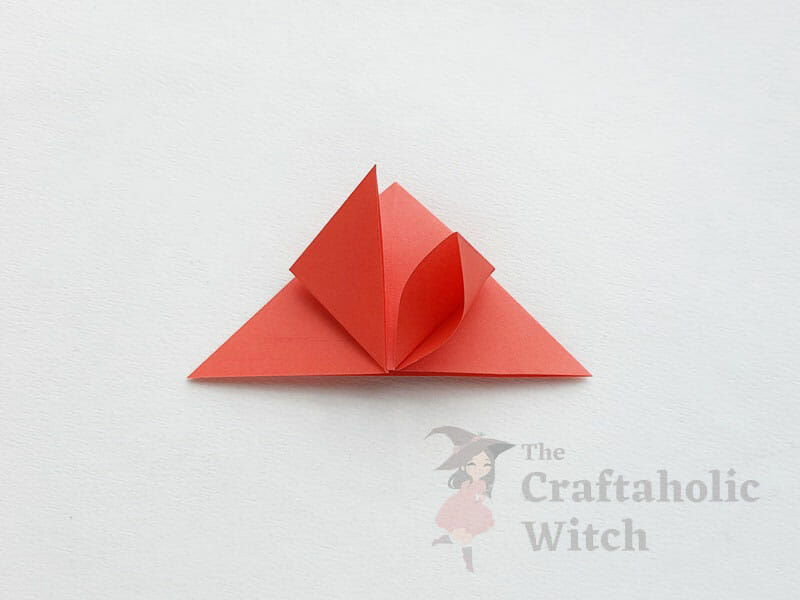
Look at one of the corners you just folded up. You’ll notice it has a pocket on the inner side. Gently slip your finger into this pocket to open it up.
This is one of the trickier steps. Be patient and gentle. The pocket is definitely there, even if it’s hard to find at first.
Step 6: Press the Pocket Down into a Square
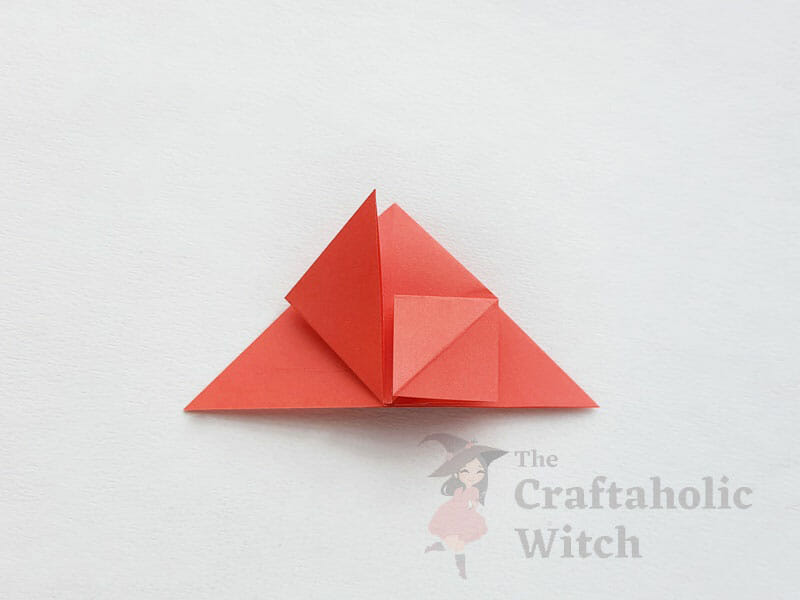
Once the pocket is open, press the top corner of the pocket down to meet the bottom center of your current shape. Flatten this pocket completely. It will form a small square shape with a diagonal crease.
This technique is called a “squash fold” in origami. You’re essentially turning a triangular flap into a square flap.
Step 7: Do the Same on the Other Corner
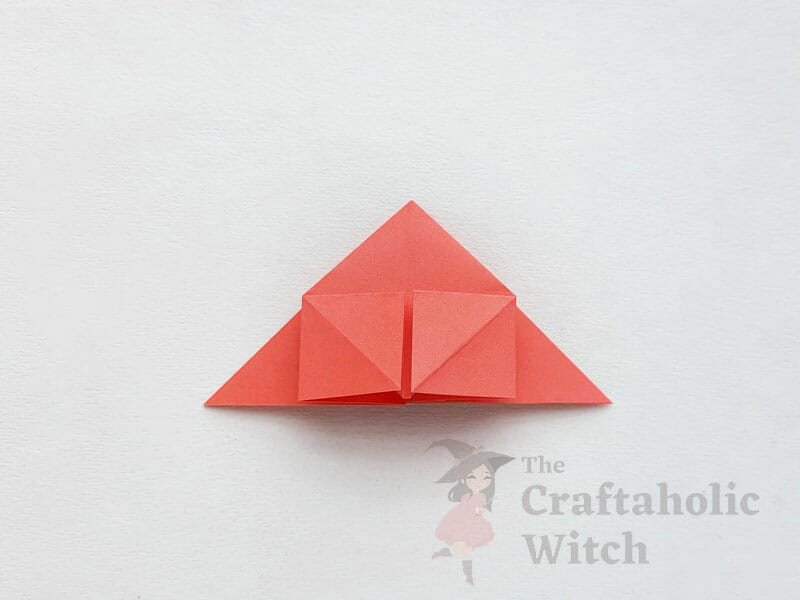
Repeat Steps 5-6 on the other folded corner. Find the pocket, open it gently, and flatten it into a matching square shape. Your shape should now have two square sections flanking a center triangular section.
Pro Tip: Both squares should look identical and be the same size. If one looks different, unfold it and try again. Symmetry matters here.
Step 8: Fold Three Corners Up Toward the Top
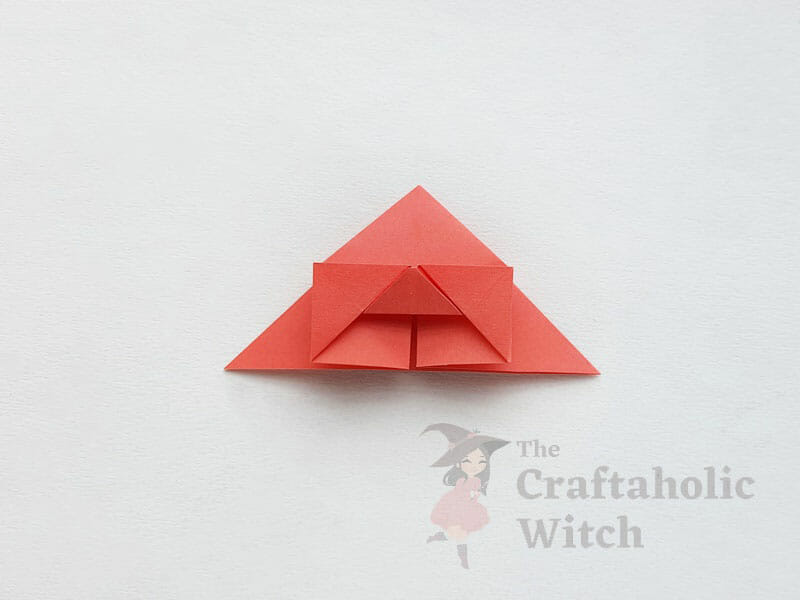
You should now see three distinct sections with corners. Fold the bottom left corner up to meet its opposite diagonal corner. Fold the bottom right corner up to meet its opposite diagonal corner. Fold the bottom center corner halfway up toward its top point (this one doesn’t go all the way).
These folds create the foundation for the rose petal shapes that will emerge later.
Step 9: Turn Over and Fold the Same Way
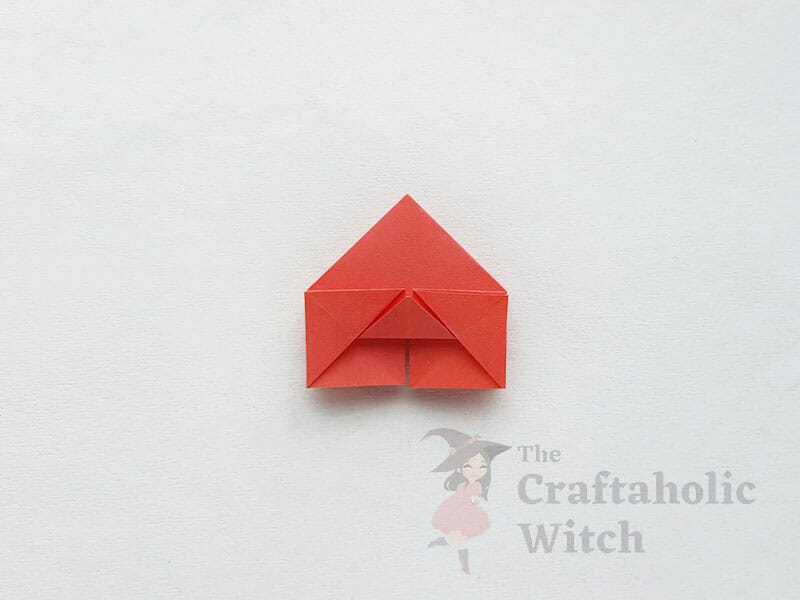
Flip the whole shape over to the other side; you’ll see the same pattern staring back at you. Repeat Step 8 here, folding up all three corners the same way you just did.
Consistency matters here. Try to make both sides as symmetrical as possible.
Step 10: Move the Layers from Side to Side
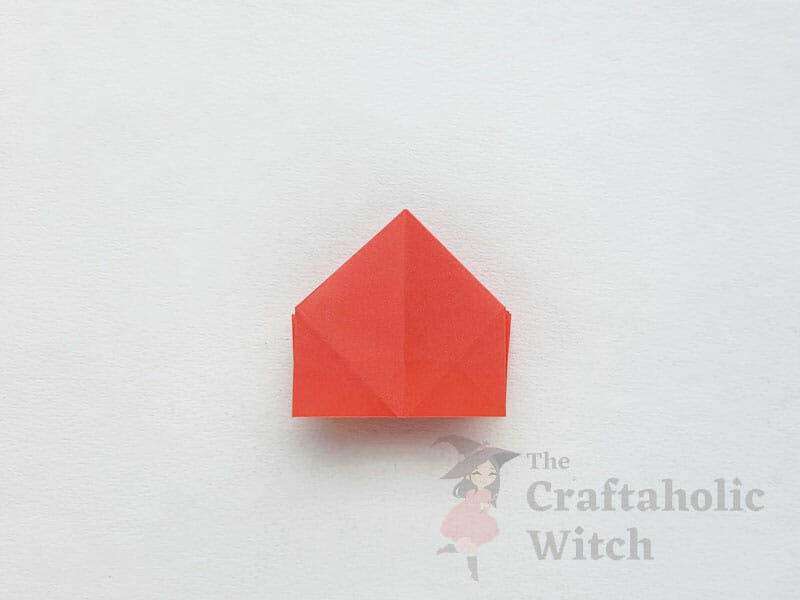
Your shape should have two flaps on the left side and two on the right side. Take the top left flap and flip it over to join the right side. Then take the bottom right flap and flip it over to join the left side. Think of it like flipping pages in a book: you’re just moving layers from one side to the other.
Step 11: Fold the Two Side Corners Inward
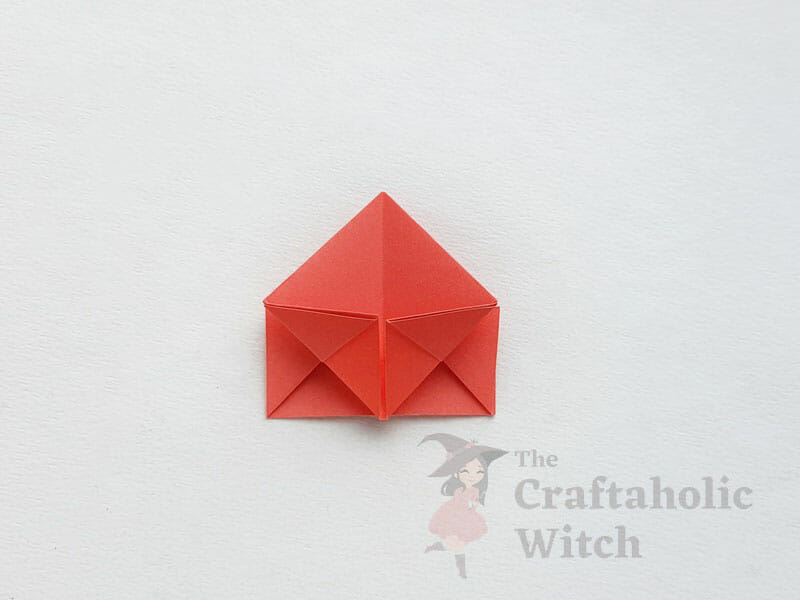
Fold the bottom left corner upward and inward, then do the same with the bottom right corner. These folds angle inward rather than straight up, and they begin shaping the base that will become the bottom of your rose.
Step 12: Fold the Center Bottom Point Up
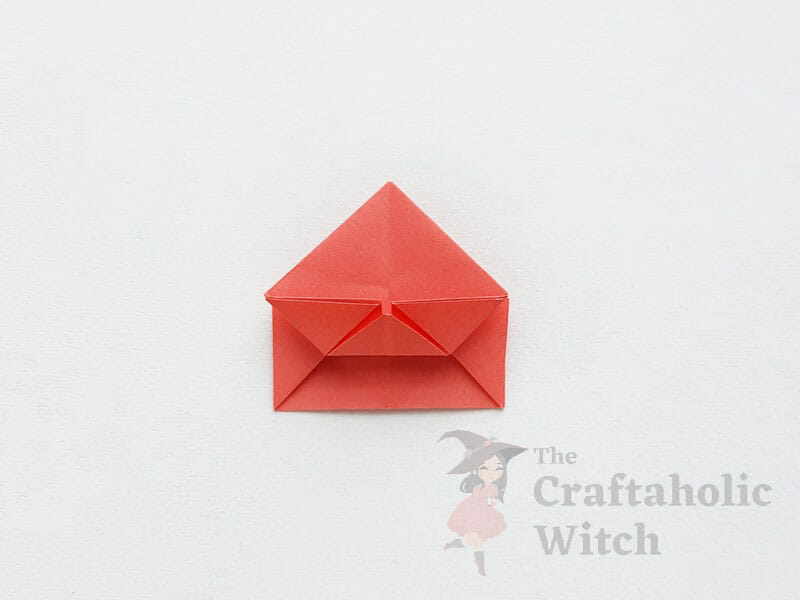
Fold the bottom center point upward. This fold joins with the folds you made in Step 11 to completely close the bottom area.
Step 13: Flip Over and Make the Same Three Folds
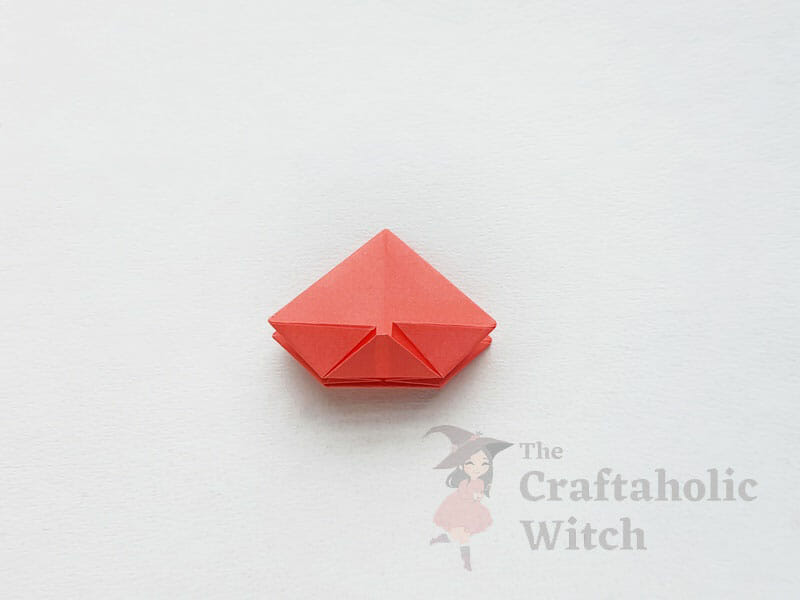
Flip everything over one more time and repeat Steps 11 and 12 on this side: fold the two outer corners inward and up, then fold the center bottom point up. That closes the bottom completely, with all the folded sections tucked inside.
Step 14: Carefully Pull the Bottom Layers Apart
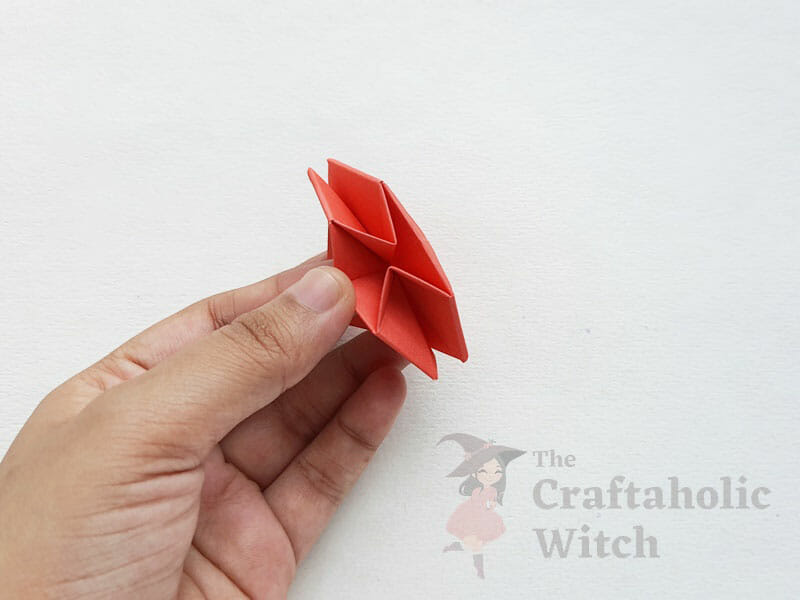
Hold your shape with the bottom facing you and gently pull apart the bottom layers to open up the base. Go slowly here. If you feel resistance, don’t force it, just work the layers open little by little so you don’t tear the paper.
Step 15: Press the Bottom Completely Flat
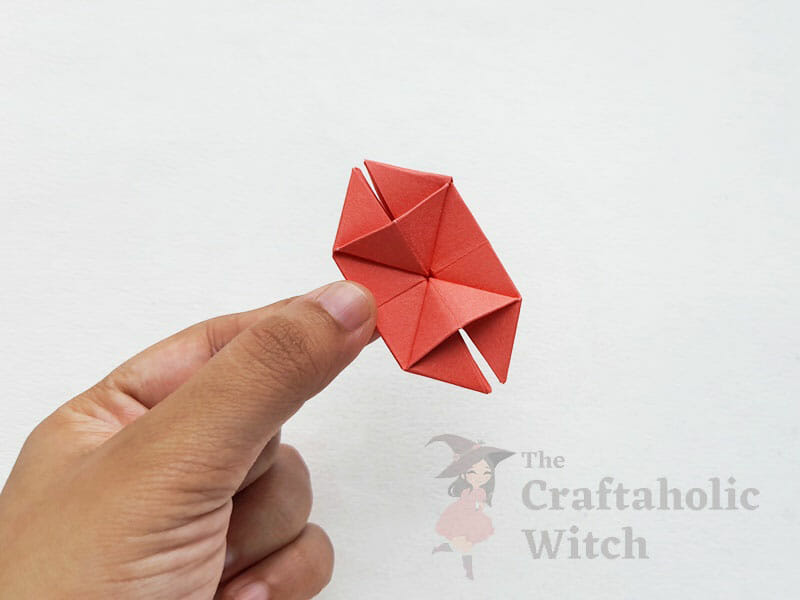
Continue opening the bottom until it lies completely flat. You should now have a flat square base at the bottom with all the folded layers emerging from the top. This flat base becomes the bottom of your rose and helps it stand upright or sit flat when glued to cards.
Step 16: Place Your Fingers Between Each Layer
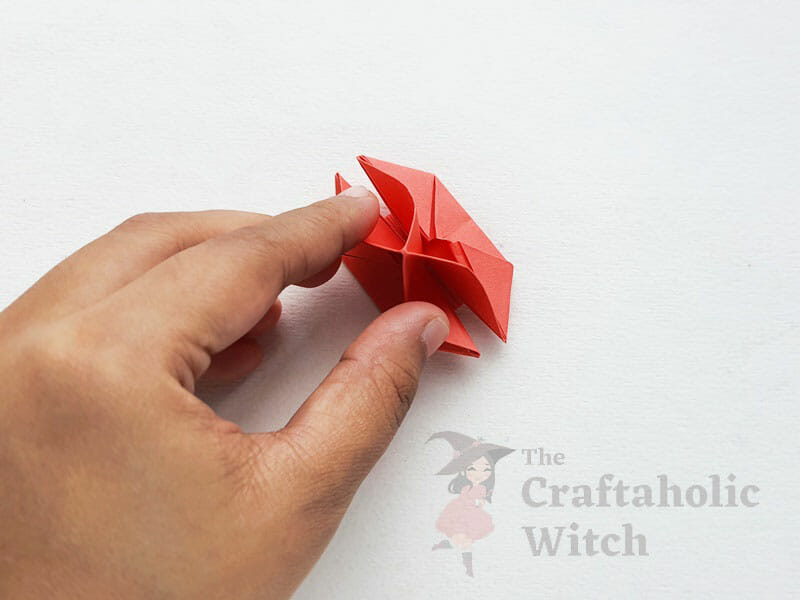
Turn your shape over so the top is facing you. You’ll see a criss-cross pattern with multiple layers radiating from the center, this is the rose bloom waiting to be formed.
Finger Positioning: Place one finger from your dominant hand into the gap between each pair of layers, spaced evenly around the center like 12, 3, 6, and 9 o’clock on a clock face. Push your fingers down about halfway into these gaps, not all the way to the bottom. Your thumb can rest on top or stay out of the way.
Step 17: Hold the Base Still and Twist the Top Clockwise
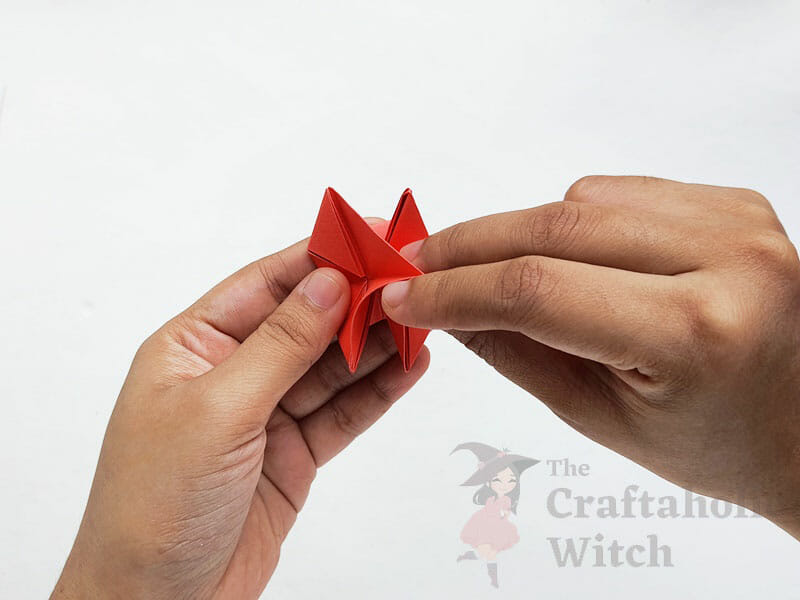
This is the make-or-break step. Read completely before starting.
How to hold the base (non-dominant hand): Pick up the entire shape and flip it so the flat square base from Step 15 faces your palm. Pinch it firmly between your thumb and fingers, thumb on top, fingers underneath, firm enough that it can’t rotate but not so tight you crush the paper. Keep this hand completely still for the whole twist. Think of it as a vise; it anchors everything.
How to twist (dominant hand): With your four fingers still in the gaps between the top layers, rotate your wrist clockwise with gentle, even pressure from all four fingers at once. The layers will spiral and wrap around each other. Take 5 to 10 seconds over it; this is a slow turn, not a quick snap.
What you should feel: smooth, gradual movement with slight resistance, all four sections moving together, and the base staying completely motionless in your other hand.
Warning: stop immediately if you feel or hear any tearing, if the base starts rotating in your anchor hand (grip it more firmly), or if one section is moving faster than the others (reposition your fingers evenly). If you hit sharp resistance, the paper may be catching on itself; gently reverse slightly and try again.
Tip: if you’re struggling, hold the base flat on a table with your non-dominant hand pressing firmly down, then use your dominant hand to twist from above. This gives you more control and stability than holding it in the air.
Step 18: Finish the Twist and Shape Your Rose Petals
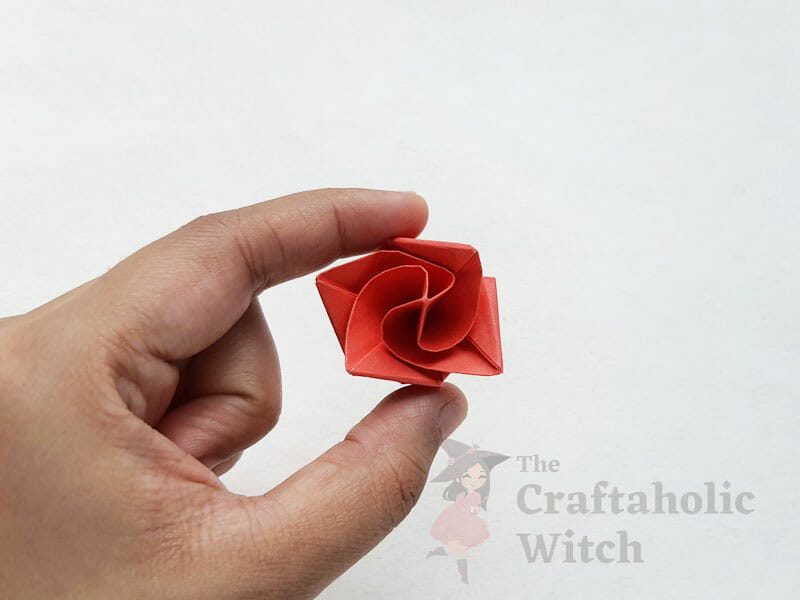
Continue twisting until you’ve rotated about 90 degrees, a quarter turn. The layers lock into a spiral and the rose settles into full bloom; you’ll feel the paper find its final position.
Release your grip on the base but keep holding it steady, then use your free hand to gently separate and arrange the petal layers. Work from the outside toward the center, pulling each layer slightly outward for fullness, and adjust the spacing so the petals spiral evenly around a tight center bud.
Note: don’t pull or tug any individual petal too hard or it might tear from the center. Gentle adjustments with your fingertips are all you need, and if a layer feels stuck, leave it as is rather than forcing it.
Congratulations! Your first origami rose might not be perfect, and that’s completely normal. The second one will be better, and by the third, you’ll have the twisting technique mastered. Each rose you make will be easier than the last.
Share it in "I Made It" and let us cheer you on.
Post your finished make in "I Made It" so the community can celebrate it with you. Cheer on other makers too. Each month, the most loved craft wins 1 year of Craftaholic Premium ($59)
Tips for Origami Roses
- Use 8×8 inch paper for your first few roses. Anything under 4×4 inches is genuinely hard to twist, so size down only once the technique clicks and you’re after something more delicate.
- Grab 3 or 4 extra sheets before you start. I’ve made hundreds of these roses and still occasionally fumble the twist, so plan on a practice round or two.
- Color sets the mood: red reads classic and romantic, pink is soft, white is elegant, yellow is cheerful. Burgundy or metallic paper makes a more formal rose if that’s what you’re after.
- A single rose is pretty, but 5 to 7 in varying sizes make a real centerpiece. Mix colors for something playful or stay monochrome for something calmer.
Frequently Asked Questions
Is there an easier way to make an origami rose?
Yes, this fold is genuinely intermediate. If you’d rather stay in origami, the origami lotus and origami leaves tutorials are easier warm-ups. If you’d rather skip the twist altogether, the rolled paper rose tutorial uses a spiral-cutting method instead, so it’s more forgiving on a first attempt, and it still looks great mixed into a bouquet with your origami roses once you’ve got those down too.
How long does it take to fold an origami rose?
Your first origami rose takes about 15 to 20 minutes, mostly spent on the creasing steps and the final twist. Once you’ve made two or three, most folders get it down to 8 to 10 minutes, since the twist stops being the mystery it is the first time.
What’s the hardest part of folding an origami rose?
The final twist in Steps 16 to 18 is the hardest part by far. It asks one hand to stay completely still while the other rotates smoothly, which feels unnatural the first time you try it. Finding the hidden pockets in Steps 5 and 6 is the other common sticking point, so if you’re stuck, those two spots are the ones to slow down for.
Do I need glue to keep the twist from unfolding?
No, a properly finished twist locks itself in place through friction between the layers and stays folded on its own. A small dot of glue at the base is only worth adding if you’re attaching the rose to something it might get bumped around on, like a gift box or a keychain.
How do I display or store finished paper roses so they last?
Keep paper roses out of direct sunlight and away from humidity, both fade and soften the paper over time. Displayed on a shelf or in a jar out of direct light, a well-made origami rose easily lasts for years, which is exactly what makes it worth folding a whole batch for your paper flower garden.
More Origami Tutorials
Share your finished origami rose in the I Made It space inside Craftaholic Community. The most-loved post each month wins a one year free Premium membership.
9 Comments
You lost me at step ten. I have no idea what that step is asking me to do.
Hello, so sorry for the confusion. I have updated the step’s written instructions, let me know if it’s clear now.
Step #10 is super confusing. I have no idea how to get past it.
No worries, you can check out our origami rose video tutorial from our YouTube channel.
This is great! Easy but elegant! wish it was a bit more detailed but after a few try’s its super easy!
Glad to know that! In case of confusion, you can check out our YouTube channel. Thanks!
I did it! its so pretty
While making these with my dad, each one he completed the rose they would slowly start expanding and flip outward. The ‘flat’ bottom wants to be in its original form. I can’t figure out what the problem is (when I make them they turn out fine). Do you have any idea of what could be going wrong?
Use lightweight/ thin craft paper. If it still doens’t stay, use a bit of glue on the twisted parts.
Join the conversation
Log in to your Craftaholic Community account to comment, ask questions, and cheer on fellow makers.
Log in to comment